
B.Tech in Electronics and Communication Engineering
A future-focused 4-year undergraduate programme combining semiconductor technology, VLSI microelectronics, embedded IoT hardware, digital signal processing, and next-generation wireless communications.
Quick Programme Facts
Programme Overview
The Department of Electronics and Communication Engineering at Modern Institute of Engineering & Technology (MIET) equips students with deep theoretical grounding and rigorous laboratory expertise spanning microelectronics, embedded systems, telecommunications, and digital signal processing. Affiliated with Maulana Abul Kalam Azad University of Technology (MAKAUT) and approved by AICTE, our curriculum bridges hardware and software, empowering graduates to excel in semiconductor design, consumer electronics, 5G communications, and smart automation.
Comprehensive four-year B.Tech programme structured across 8 semesters under the MAKAUT Choice Based Credit System (CBCS).
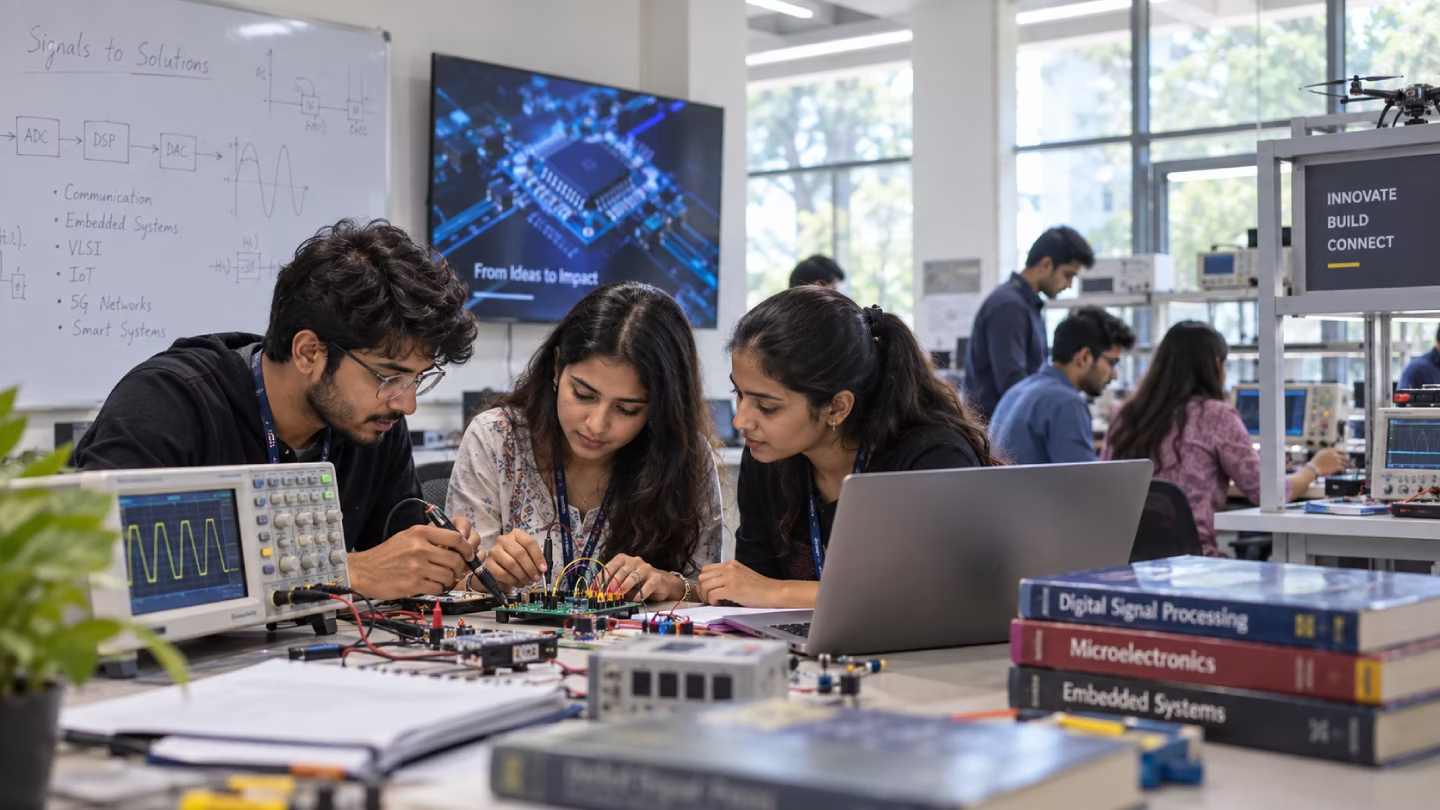
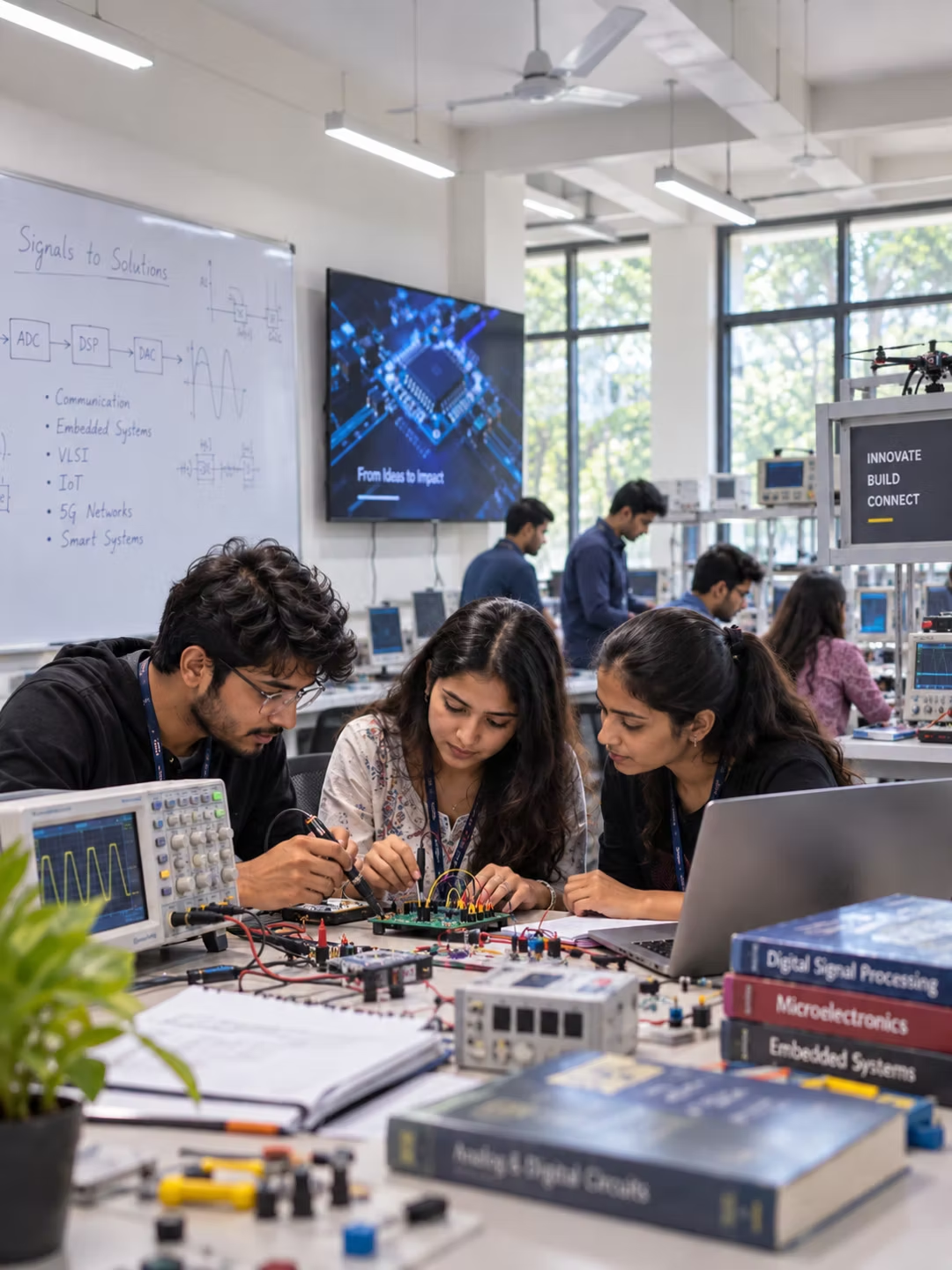
Advanced hardware laboratories featuring DSO oscilloscopes, function generators, FPGA development kits, and microcontroller trainers.
Hands-on simulation pedagogy using MATLAB, Simulink, Multisim, Keil uVision, and open-source EDA tools.
Dedicated pre-placement coaching for both core electronics enterprises (semiconductor, hardware, telecom) and mainstream software IT industries.
Why Study Electronics & Communication Engineering at MIET?
MIET Bandel combines well-equipped electronics laboratories, experienced faculty mentors, and industry-oriented training to nurture tomorrow's hardware engineers and communication researchers.
Modern electronics, microwave, and VLSI test benches with precision instrumentation, spectrum analyzers, and DSO modules.
Dual career advantage: strong core engineering foundation that unlocks careers in both hardware microelectronics and software engineering.
Regular technical workshops on Embedded C, Arduino, Raspberry Pi, ARM Cortex architectures, and Internet of Things (IoT).
Full institutional Book Bank scheme providing every student with core textbooks throughout each academic semester.
Active guidance for national competitive examinations including GATE, ESE, and Public Sector Undertaking (PSU) recruitments.
Programme Highlights
Differentiating academic modules designed to build high-demand technological competencies.
VLSI & Microelectronics
In-depth study of CMOS circuit design, ASIC flow, FPGA prototyping, and layout verification using EDA design suites.
Embedded Systems & IoT
Hands-on programming of 8051, AVR, ARM Cortex-M, and ESP32 platforms for industrial automation and smart edge computing.
Digital Signal & Image Processing
Algorithmic transformation, filter design, audio-visual signal analysis, and DSP processor implementation with MATLAB.
Wireless & 5G Telecommunications
Microwave propagation, cellular architectures, optical fiber transmission, and modern satellite communication protocols.
Eligibility Criteria
Candidates seeking admission to the 4-Year B.Tech in Electronics and Communication Engineering must comply with academic prerequisites prescribed by AICTE and the Department of Higher Education, Govt. of West Bengal.
Lateral Entry & Verification Notes
- •Holders of 3-year Engineering Diplomas in relevant branches or B.Sc graduates with Mathematics are eligible for direct Lateral Entry into the 2nd Year (3rd Semester) via JELET.
- •Physical document verification of original rank card, mark sheets, and domicile certificate is mandatory during on-campus reporting.
Admission Procedure & Guidelines
Admissions are facilitated through WBJEEB centralized online counselling, complemented by institute-level management quota procedures as per regulatory notifications.
Appear for WBJEE or JEE Main entrance examinations and secure an eligible merit rank.
Register for the Centralized e-Counselling portal managed by WBJEEB.
Choose Modern Institute of Engineering & Technology (MIET) - ECE as a preferred choice in the choice filling window.
Upon allotment, visit the MIET Bandel admission office for document verification, counseling formalities, and fee enrollment.
Programme Fee Structure & Semester Schedule
Official institutional fee breakdown for Academic Session 2026-27 approved for B.Tech (Bachelor of Technology). All semester fee schedules are transparently published without hidden charges.
4-Year B.Tech & Lateral Entry Fee Schedule
| Discipline | Total Fees | Admission + 1st Sem | 2nd Sem | 3rd Sem | 4th Sem | 5th Sem | 6th Sem | 7th Sem | 8th Sem |
|---|---|---|---|---|---|---|---|---|---|
| 1st Year Regular Admissions (4-Year Programme) | |||||||||
Computer Science & EngineeringCSE 1st Year Admission | ₹2,80,000 | ₹56,000 | ₹32,000 | ₹32,000 | ₹32,000 | ₹32,000 | ₹32,000 | ₹32,000 | ₹32,000 |
Electronics & Communication EngineeringECEThis Course 1st Year Admission | ₹2,00,000 | ₹46,000 | ₹22,000 | ₹22,000 | ₹22,000 | ₹22,000 | ₹22,000 | ₹22,000 | ₹22,000 |
Civil EngineeringCE 1st Year Admission | ₹2,00,000 | ₹46,000 | ₹22,000 | ₹22,000 | ₹22,000 | ₹22,000 | ₹22,000 | ₹22,000 | ₹22,000 |
Mechanical EngineeringME 1st Year Admission | ₹2,00,000 | ₹46,000 | ₹22,000 | ₹22,000 | ₹22,000 | ₹22,000 | ₹22,000 | ₹22,000 | ₹22,000 |
Electrical EngineeringEE 1st Year Admission | ₹2,00,000 | ₹46,000 | ₹22,000 | ₹22,000 | ₹22,000 | ₹22,000 | ₹22,000 | ₹22,000 | ₹22,000 |
| Lateral Entry Admissions (JELET — Direct 2nd Year Admission) | |||||||||
Computer Science & EngineeringCSE, LAT Lateral Admission (JELET) | ₹1,60,000 | ₹45,000 Initial Entry Fee | — | — | ₹23,000 | ₹23,000 | ₹23,000 | ₹23,000 | ₹23,000 |
Electronics & Communication EngineeringECE, LATThis Course Lateral Admission (JELET) | ₹1,45,000 | ₹45,000 Initial Entry Fee | — | — | ₹20,000 | ₹20,000 | ₹20,000 | ₹20,000 | ₹20,000 |
Civil EngineeringCE, LAT Lateral Admission (JELET) | ₹1,80,000 | ₹55,000 Initial Entry Fee | — | — | ₹25,000 | ₹25,000 | ₹25,000 | ₹25,000 | ₹25,000 |
Mechanical EngineeringME, LAT Lateral Admission (JELET) | ₹1,80,000 | ₹55,000 Initial Entry Fee | — | — | ₹25,000 | ₹25,000 | ₹25,000 | ₹25,000 | ₹25,000 |
Electrical EngineeringEE, LAT Lateral Admission (JELET) | ₹1,80,000 | ₹55,000 Initial Entry Fee | — | — | ₹25,000 | ₹25,000 | ₹25,000 | ₹25,000 | ₹25,000 |
Curriculum & What You Will Study
Comprehensive academic syllabus integrating core principles, hands-on laboratory experimentation, and industry-oriented electives.
Semester 1
Core science fundamentals, calculus, and basic engineering foundations.
Core Subjects & Laboratories (6 modules)
Core Electronics & Communication Domains
Foundational domains mastered throughout the four years of engineering study.
Laboratories & Practical Learning
The ECE department maintains advanced laboratory suites facilitating circuit fabrication, real-time waveform inspection, microprocessor programming, and high-frequency communication testing.
Analog Electronics Lab: Dual-trace oscilloscopes, signal generators, power supplies, and analog circuit characterization rigs.
Digital Electronics & Logic Lab: Digital IC testers, logic analyzers, and breadboard prototyping units for combinational/sequential circuits.
Microprocessor & Microcontroller Lab: 8085, 8086, 8051, and ARM Cortex trainer kits with peripheral interfacing boards (stepper motors, ADC, DAC).
VLSI & DSP Simulation Lab: High-end workstations running MATLAB, Simulink, Xilinx ISE, and open-source EDA tools for Verilog modeling.
Microwave & Optical Fiber Lab: Microwave test benches with Klystron tubes, Gunn oscillators, slotted lines, and optical attenuation measurement kits.
IoT & Embedded Hardware Lab: Arduino, ESP32, Raspberry Pi boards, sensor shields, and RF communication modules for project prototyping.
Projects & Hands-On Engineering
Hands-on hardware and firmware development form the core of student training across all four years.
Embedded Automation: Smart campus lighting, automated irrigation, and RFID-based attendance hardware developed by student teams.
Wireless Telemetry: LoRaWAN and ZigBee sensor nodes designed for agricultural environmental monitoring.
Signal & Speech Processing: Real-time noise cancellation and speech pattern recognition implemented on DSP development boards.
Industry-Sponsored Final Projects: Capstone research tackling biomedical health monitoring, electric vehicle telemetry, and RF circuit optimization.
Skills Students Develop
A balanced mix of hard technical capabilities, engineering analytics, and workplace professionalism.
Technical Proficiencies
- Circuit Analysis & Breadboard Prototyping
- Embedded C / C++ Programming
- Microcontroller Architectures (ARM, 8051, AVR, ESP32)
- Hardware Description Languages (Verilog HDL)
- MATLAB & Simulink Mathematical Modelling
- PCB Design & Schematic Capture (KiCad / Multisim)
- RF & Microwave Measurement Techniques
Professional & Workplace
- Multidisciplinary Team Collaboration
- Technical Schematic Documentation
- Laboratory Safety & Equipment Maintenance
- Engineering Ethics & Compliance
- Structured Technical Presentation
Analytical & Engineering
- Analog Waveform Diagnostics & Troubleshooting
- Signal Analysis in Time & Frequency Domains
- Power Budgeting & Circuit Optimization
- Quantitative System Reliability Analysis
Career Opportunities & Placement Pathways
Graduates of B.Tech ECE enjoy a dual career advantage, possessing qualifications for core electronics enterprises, semiconductor multinationals, telecommunication giants, and software technology leaders.
Key Job Profiles & Designations
Recruiting Industry Sectors
- •Semiconductor & Integrated Circuit Fabrication
- •Telecommunications & Cellular Networks (5G)
- •Automotive Electronics & Electric Vehicles (EV)
- •Aerospace & Defence Systems
- •Consumer Electronics & Smart Appliances
- •Information Technology & Software Services
Higher Studies & Competitive Exams
- •M.Tech in VLSI Design / Microelectronics / Embedded Systems via GATE
- •Master of Science (MS) in Electrical & Computer Engineering abroad
- •Public Sector Undertakings (PSUs) via GATE: ISRO, DRDO, BEL, BSNL, BHEL, NTPC
- •MBA in Operations / Technology Management
* Placement offers depend on individual academic records, technical expertise, and interview evaluations. MIET provides dedicated training for both core hardware and software campus recruitment drives.
Industry Readiness & Employability Training
MIET conducts comprehensive training modules bridging the academic syllabus and modern hardware engineering demands.
Embedded Systems & IoT Bootcamps: Practical certificate courses covering ARM microcontrollers and cloud connectivity.
MATLAB & Circuit Simulation Sprints: Guided hands-on sessions for DSP, filter design, and mathematical modelling.
Core & Software Dual Track Coaching: Parallel training tracks preparing students for both hardware technical interviews and software coding rounds.
Guest Seminars by Telecom & Semiconductor Experts: Sessions discussing 5G rollouts, chip fabrication advances, and green electronics.
Academic Resources & Infrastructure
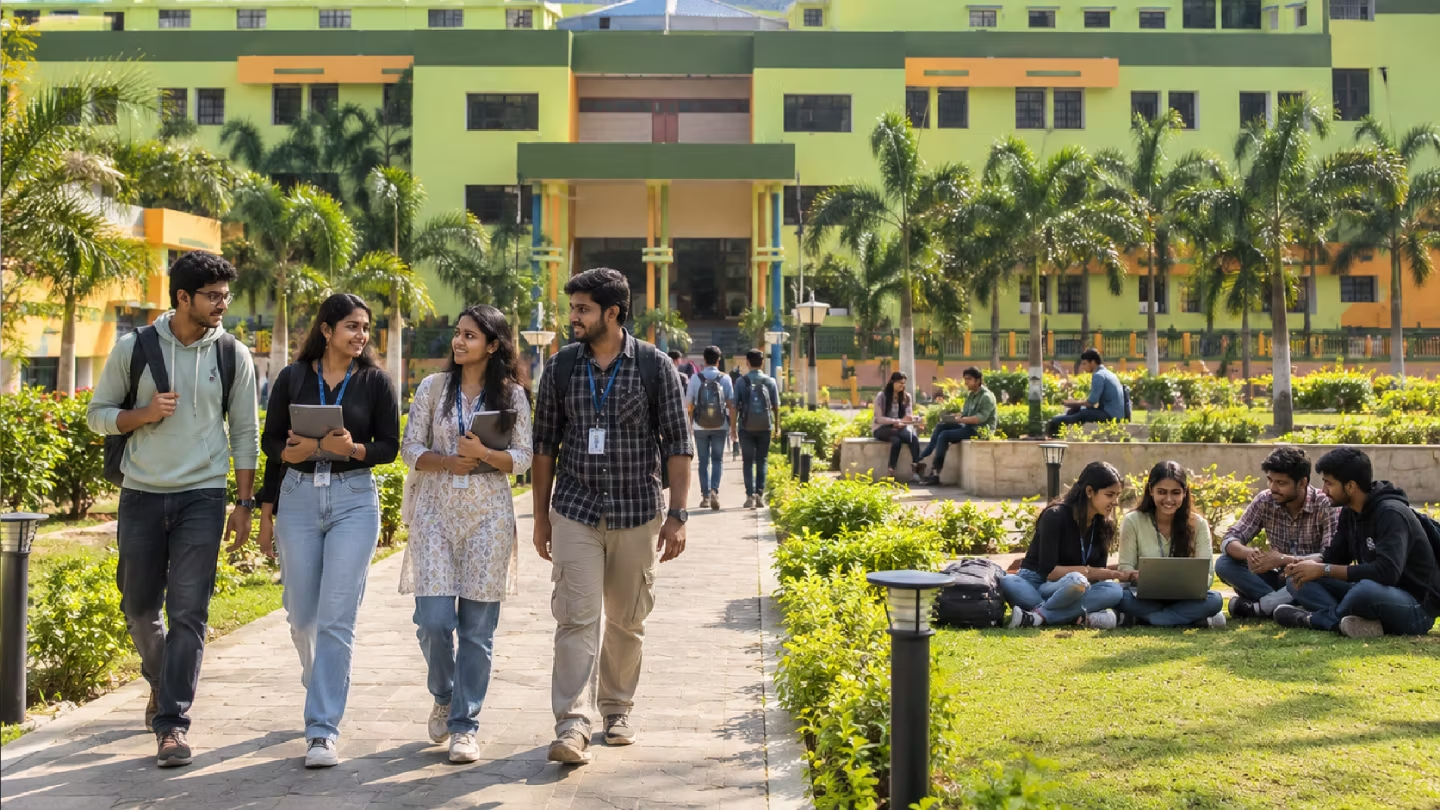
ECE students benefit from comprehensive academic, laboratory, and library resources on the MIET Bandel campus.
Research & Technological Innovations
Our faculty and students actively investigate cutting-edge challenges in communication, renewable energy monitoring, and embedded microelectronics.
Low-Power IoT Node Development: Energy-harvesting sensor nodes designed for off-grid environmental surveillance.
Biomedical Sensor Interfacing: Portable non-invasive monitoring systems utilizing analog front-end conditioning circuits.
Antenna Array Optimization: Microstrip patch antenna designs for high-frequency short-range wireless communication.
National Technical Paper Presentations: Student papers regularly accepted in Springer, IEEE, and national conferences.
Student Alumni Success
ECE alumni from MIET are contributing to world-class semiconductor firms, telecom leaders, and global software organizations.
“The practical lab work in microcontrollers and circuit debugging at MIET gave me the practical edge needed during technical hiring rounds. The professors guided every step of my journey.”

Rohan Mukherjee
Embedded Hardware Associate • Tier-1 Industrial Automation Firm
Batch of 2024“MIET's comprehensive communication labs and Book Bank support allowed me to master complex RF and signal processing concepts without any resource barriers.”
Priyanka Mondal
Telecom Network Engineer • National Telecommunications Provider
Batch of 2023Authentic Programme Transparency
Verified & Approved by Academic Affairs CellFrequently Asked Questions: B.Tech in Electronics and Communication Engineering
Find clear answers regarding MIET College admissions, academic approach, campus facilities, and research initiatives.
What is the scope of B.Tech Electronics & Communication Engineering today?
Can an ECE graduate get recruited in IT and software companies?
Are diploma holders eligible for lateral entry into 2nd year B.Tech ECE?
What laboratory equipment is accessible to ECE students at MIET?
Does MIET assist students in preparing for GATE and PSU exams?
Begin Your Engineering Journey in B.Tech in Electronics and Communication Engineering
Secure your seat at Modern Institute of Engineering & Technology (MIET). Approved by AICTE, affiliated with MAKAUT / WBSCTVESD, and located conveniently in Bandel, Hooghly.